Car Battery in Cold Weather: Why It Fails, How to Test and Jump It
Cold slows a car battery's chemistry while making the engine harder to crank. How to test a battery at home and jump-start a car in the right order.
Car batteries fail in cold weather because low temperatures slow the chemical reaction that produces current, while cold, thick engine oil makes the starter work harder. A battery that was already weak in the fall often gives out on the first very cold morning. You can check one at home with a voltmeter (a healthy, fully charged battery reads about 12.6 volts with the engine off), and you can jump-start a car safely if you connect the cables in the right order.
Why do car batteries die in winter?
A lead-acid battery stores energy as a chemical reaction between lead plates and sulfuric acid. Cold slows that reaction, so the battery can deliver less current at the moment the engine needs the most. At the same time, motor oil thickens in the cold and the starter motor has to turn a stiffer engine.
Other things add to the load in winter:
- Short trips do not give the alternator enough time to recharge the battery after a cold start.
- Heated seats, the rear defroster, headlights and the blower fan all draw power, often all at once.
- Summer heat speeds up wear inside the battery, and that damage tends to show up the following winter.
- A battery left partly discharged for long periods builds up sulfate on its plates and holds less charge.
Most car batteries last roughly three to five years. If yours is in that range or older, winter is when it is most likely to quit. Electric cars face their own cold-weather problem, covered in our guide to how much range EVs lose in the cold, but they still carry a small 12-volt battery that can fail the same way.
What are the warning signs of a weak battery?
The most common sign is a slow, labored crank: the engine turns over sluggishly before it starts. Watch for these too:
- Headlights or dash lights that dim when you start the car or at idle.
- A clicking sound and no crank when you turn the key or press the start button.
- A battery warning light on the dashboard.
- White or blue-green crust on the terminals.
- A swollen or cracked battery case, or a smell like rotten eggs. Stop using a battery that shows either of these and have it replaced.
How do you test a car battery at home?
A basic digital multimeter gives a useful first reading. Test with the engine off, ideally after the car has sat for a few hours so any surface charge has faded.
- Set the meter to DC volts (the 20-volt range if it is not auto-ranging).
- Touch the red probe to the positive (+) terminal and the black probe to the negative (-) terminal.
- Read the voltage. About 12.6 volts or a little higher means fully charged. Around 12.4 volts is roughly three-quarters charged, around 12.2 volts is about half, and 12.0 volts or less means the battery is discharged.
- Start the engine and check again. With the engine running, a healthy charging system usually shows roughly 13.7 to 14.7 volts. A reading near battery voltage points to an alternator problem.
A voltage reading shows state of charge, not how much cranking power is left. A battery can read 12.6 volts and still fail under load. A load test or an electronic battery tester checks that, and many auto parts stores will run one for free. If the battery is weak, compare the replacement’s cold cranking amps (CCA) rating with what your owner’s manual calls for. CCA measures how much current the battery can deliver at 0°F (-18°C).
How do you jump-start a car safely?
Read the jump-starting section of your owner’s manual first. Some vehicles, including many hybrids and EVs, have dedicated jump points under the hood, and a few manufacturers say not to use the car to jump another vehicle. Then follow this order:
- Park the working car close to the dead one without letting the cars touch. Turn both off, set the parking brakes and switch off lights and accessories.
- Check the dead battery. Do not jump a battery that is cracked, leaking or bulging, or one that looks frozen (ice in the case or a bulged side). A frozen battery can burst when charged.
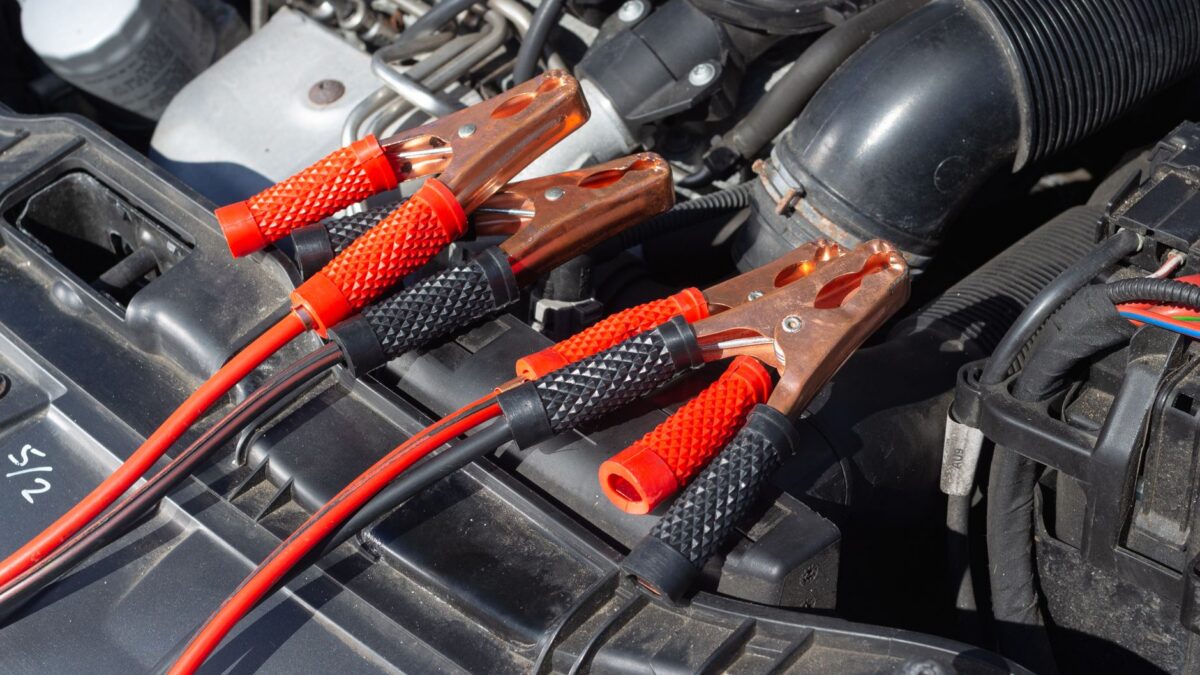
- Connect one red (positive) clamp to the + terminal of the dead battery.
- Connect the other red clamp to the + terminal of the good battery.
- Connect one black (negative) clamp to the – terminal of the good battery.
- Connect the last black clamp to a bare, unpainted metal part of the dead car’s engine block or frame, away from the battery. Batteries can give off hydrogen gas, and the final connection can spark, so keep it away from the battery.
- Start the working car and let it run for a few minutes. Then try to start the dead car. If it does not start after a few short tries, stop and call for help instead of cranking for long stretches.
- Once it starts, remove the cables in reverse order: black from the metal ground, black from the good battery, red from the good battery, red from the formerly dead battery. Keep the clamps from touching each other.
Drive the car for at least 20 to 30 minutes, ideally at steady speed, so the alternator can put some charge back. Then test the battery. A battery that needed one jump may be close to the end of its life.
Is a portable jump starter safer than cables?
A portable lithium jump starter lets you start a car without a second vehicle, and most models have protection against reversed clamps. Keep it charged, since it loses charge over time and works less well when very cold. The clamp order is the same: red to positive first, black to ground, and follow the instructions on the unit.
How can you keep a battery healthy through winter?
- Clean corrosion off the terminals with a wire brush and a mix of baking soda and water, wearing gloves and eye protection, and make sure the clamps are tight.
- Combine short errands into longer drives so the battery recharges.
- Use a smart battery maintainer (trickle charger) if the car sits for days or weeks.
- Park in a garage when you can.
- Have the battery tested before the first hard freeze if it is three or more years old.
Battery cables and connections can also be the subject of safety recalls, as with the Ford Maverick hybrid battery cable recall. You can check any vehicle for open recalls by VIN at NHTSA, and the repair is free at a franchised dealer. If a battery keeps going flat even after a replacement, have a mechanic check for a parasitic drain or a failing alternator.
Quick answers
Can a dead battery recover after a jump?
A healthy battery that was simply drained, for example by headlights left on, usually recovers after a long drive or a full charge from a battery charger. An old battery that went flat on a cold morning often will not hold a charge for long.
Should I idle the car to charge the battery?
Idling charges a battery slowly. Driving charges it faster, and a plug-in charger is the most complete option.
Is it safe to jump-start a car in the rain or snow?
The 12-volt system is low voltage, so it can generally be done in wet weather. Keep the clamps and cable ends off wet ground, wear gloves, and follow the same connection order.
How long does a car battery last?
Most last about three to five years. Heat, frequent short trips and long periods of sitting unused can shorten that.